Mārtaṇḍa (मार्तण्ड): Birth of the Sun
In the age when the sky still remembered it had once been an ocean, there was a family at war with itself. This is not unusual. Families are often at war with themselves. What was unusual was that it wasn't a war between mortal men.
The Devas and the Asuras came from the same blood. The father Kashyapa was a patient sage who fathered many celestial beings. His wife Aditi gave birth to the Devas (देव). From her sisters Diti and Danu came the Daityas (दैत्य) and Danavas (दानव), the ones we call Asuras. Different mothers, same blood, and the hunger for the three worlds. The two sides of one family were at war over who would rule all three worlds.
And the Asuras (असुर) were winning.
One by one, Prithvi (पृथ्वी), the earth, Patala (पाताल), the dark realms below and Swarga (स्वर्ग) itself, the heaven the Devas had called home, all three realms went dark, the way a lamp goes dark when you cup your hand around it, not blown out, merely starved of air. The Devas, driven out of their own paradise, wandered without a home, and wherever they walked, the light itself began to fade from the sky and the world was slowly going dark.
Aditi, the mother of the Devas could not bear the look on her children's faces. A mother can endure most sorrows but not the sorrow of having given her children a world and then watching it taken from them.
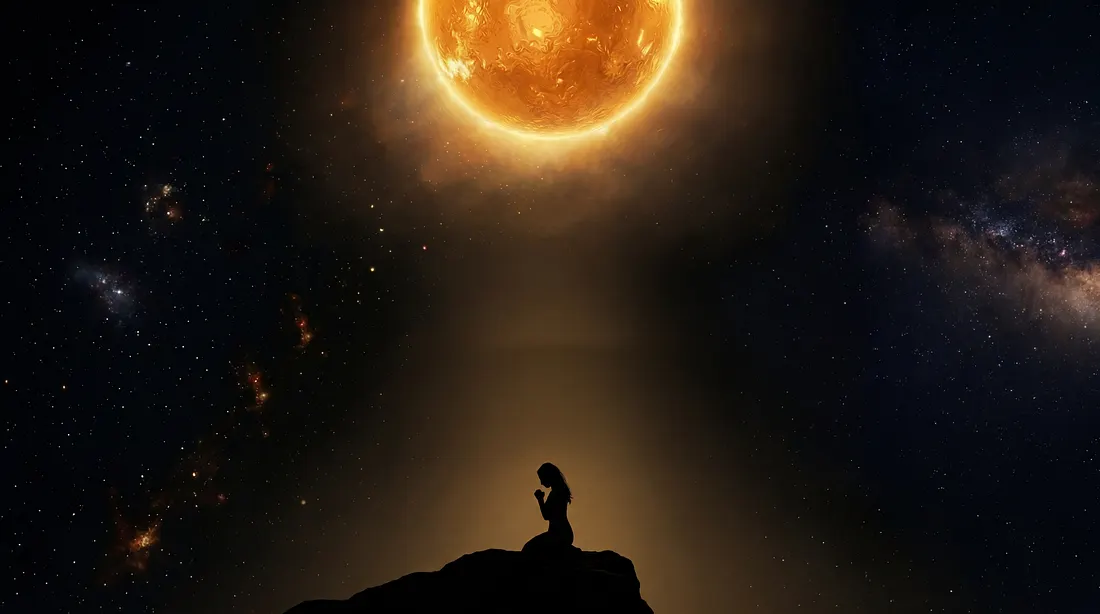
So she turned to Surya (सूर्य) — the Sun himself. She fasted. She prayed. She made an offering of her own body, the way only mothers know how to. At last Surya appeared before her, glowing like molten copper, and asked what she desired.
No armies, no weapons, not even a boon of power, she asked him to be born as her son instead. As her son she wanted him to destroy the Asuras and win back what her children had lost. The Sun agreed to enter her womb as a single ray, for his fullness would have burned her from the inside out, and with that one ray, to enter the war that even the gods were losing.
Surya agreed. So, from the thousands he sent one ray and she carried it.
Months passed. Aditi kept her fasts, held her silences, and ate less and less. She grew more and more luminous, the way a lamp burns brighter even when its oil runs low. Kashyapa watched this and grew afraid. Finally, one day he could stay silent no longer. He said to her, in anger, or in fear, "You will kill what you are carrying. This child is as good as dead."
Aditi looked at him calmly, without fear. "This child will not die," she said. "He will be the death of evil." And then, in the heat of that exchange, she brought the child into the world.
Because the first words spoken over him were a father's declaration that "he is as good as dead", they named him Mārtaṇḍa. From mṛta — dead (मृत), and aṇḍa (अंडा) — the egg, the womb. The one called dead before he had opened his eyes.
Interestingly, the old sages seemed to understand what took years for scientists and astronomers to discover: a star is born from death. It is born from the dust that drifts in the cold for ages, until gravity begins to pull it back together, tighter and hotter, until something ignites. A sun too is born from the cosmic dust.
Mārtaṇḍa opened his eyes, and the darkness had nowhere left to stand.
The Asuras had grown comfortable in shadow and had stopped believing the light would return. When Mārtaṇḍa rose over the battlefield, light reached into every corner, every grey space they had made their home. Nothing could hide from him. Not ambition dressed as righteousness. Not old cruelty wearing the face of order. Where his light fell, things simply became visible, and visibility was enough.
The Devas too, wandering so long, had forgotten their might. They straightened, remembered who they were and stepped forward. Indra led them, as Indra always does, impulsive, glorious, better at beginnings than at whatever comes after. The war that had run one way for so long turned in a single morning. With a single glance Mārtaṇḍa burned away what had corrupted the heavens, and the three worlds returned to those they belonged to.
This is who the Sun is, and why he enters a chart
He is a warrior. He is not a gentle planet. He is the one who burns away what is false and sets right what has been broken. This is why the old texts call him Krura, cruel. His fire burns and separates, scorching whatever stands too close. But there is no malice in it. It is a clean cruelty, harsh yet pure. When it arrives in a chart, it scorches away all that is wrong and false inside and out, and calls you back to your truest purpose.
He is the king. His lineage runs back to Brahma himself, the very creator of the universe. And from him came the great lineage of kings, rulers, administrators and builders. So when the Sun stands strong in a chart, that person finds themselves drawn toward leadership, administration or authority, because somewhere in their blood runs the memory of a lineage that once restored order across all three worlds.
He is also the body's will to live. The old texts call him the power of immunity and the light that dispels darkness, and so his war is not only fought on battlefields. It is fought in the bones, in the blood, against weakness and illness.
But here is what is often less obvious about him: he gives, unconditionally.
Every morning, without being asked and without being thanked, he pours out the same light on the field of the king as on the hut of the woman who has nothing. The sun does not curate its warmth. It does not calculate. It pours itself out on everything, equally. This is his nature, not a choice he makes each morning. And in the giving, he burns away a little of himself. Just like the ray it sacrificed for Aditi, so the world order could be restored.
That is Mārtaṇḍa. The Sun. The soul, the king, the warrior who burns away what is false, and the one who gives a little of himself so that the right order of things may hold.