Sangya and Chhaya (संज्ञा और छाया):
The Wife and the Shadow
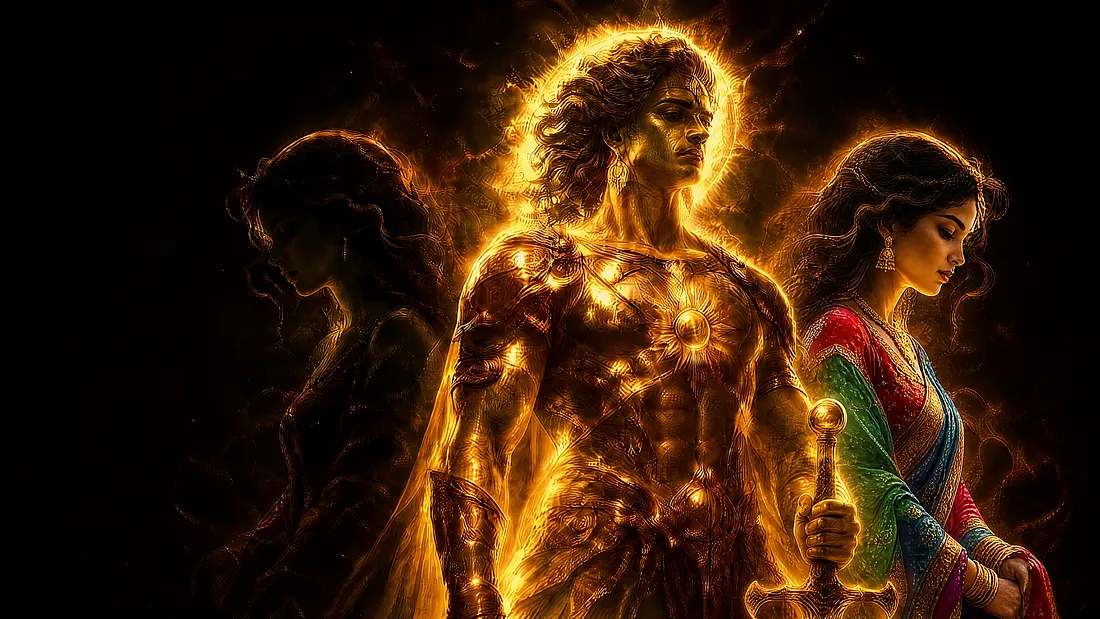
Long ago, the Sun married Sangya (संज्ञा), daughter of Vishvakarma (विश्वकर्मा) — the architect who had raised the shining cities of the gods and shaped the worlds those cities stood on. She was radiant, and devoted, and for a long while that was simply enough. She gave him three children: Vaivasvata Manu, who would become the legendary first man, ancestor of the human race, and its first lawgiver; Yama, who would come to stand at the door every life must pass through; and Yami, who would become the river Yamuna, and in time forget, as rivers do, that she had ever been anything else. For years this was the whole of their life together. The children grew. The household held.
But slowly, and through no real fault on either side, something began to come apart between them. The Sun was the Sun, and his nature was to give life to the whole world, though only from a distance. Up close, that same warmth turned unbearable. Sangya lived up close. Day after day she turned her face from him, and bore it quietly, beside the very man she loved.
She could not leave him, and she could not go on as she was, so she did something strange and sorrowful instead. Out of her own shadow she shaped another woman, identical to her in every way. She called her Chhaya (छाया), which is what you call a shadow once it has learned to walk on its own. She asked Chhaya to take her place, to raise her children, to keep the secret between them. And she herself transformed into a mare, slipped away north, to the cold edge of the world, to sit with her penance far from his heat.
The Sun never noticed the difference. He looked at Chhaya and saw his wife. He lived beside her as he always had, and in time she gave him children of her own: Shanicharaya, who would grow to weigh every soul's deeds and hand back exactly what was earned; Savarni Manu; and two daughters, Tapti and Vishti.
But a shadow, however faithfully it wears a face, cannot love the way a woman loves her own children. Chhaya warmed only to her own children and turned cold toward Sangya's. The children felt that coldness long before they had words for it.
It was Yama who could not bear it any longer. The unfairness of it burned in his young mind. He was young, and the unfairness of it burned in him. One day, in a moment of rage, he raised his foot against her. Then, at the last instant, he held it back. He did not strike.
This is the moment his name was truly earned. Yama means restraint.
Chhaya was not as magnanimous or loving as a true mother. In her fury, she cursed him anyway. "Your foot would wither," she said, "and rot, and worms would crawl through it."
Yama, still a boy afterall, ran weeping to his father. A curse, once spoken, cannot be unspoken. Even the Sun could not undo it. But he could weaken it, and this he did: he softened the curse so that only a little flesh would fall away, not the whole foot, and his son was spared the worst of it. But the curse itself left him uneasy. No true mother curses her own child, and yet she had. The thought lodged in him and would not leave. Something here was not what it seemed.
He went to her and asked her outright, but she would not answer. His old fire rose in him. He seized her by the hair and lifted his hand to curse her where she stood, and only then did she finally break. "I am not Sangya," she told him. "I am only her shadow. Your wife could not bear your heat so she created me."
In his fury, the Sun went straight to the one who would know the truth. Vishvakarma did not shrink from him. He said the thing no one else had dared to say. "You are too much," he told him. "Your heat and your glare are more than any living thing can stand. Even your own wife couldn't bear it."
Then the architect did what only the maker of the gods' own tools could do. He set the Sun upon his own grinding wheel, the one on which he shaped the weapons and instruments of the gods, and ground away a portion of his fire, a full eighth of it, until what remained could finally be looked upon without flinching. The ancient texts say he came off that wheel not only gentler, but more beautiful. His light was turned round and whole, no longer raw. The shavings ground off the Sun's fire were kept and later shaped into the Sudarshana.
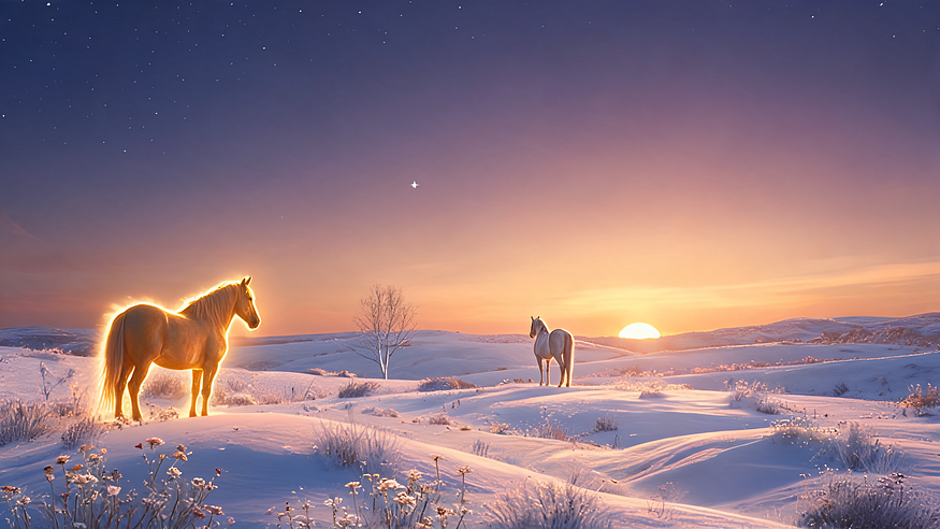
Gentled now, the Sun went looking for his wife. He assumed the form of a horse and found her grazing at the north pole, still a mare. When she saw him coming, she ran once again, afraid of the same scorching heat as she remembered. But as he drew nearer, she sensed that the fire was no longer what it had once been. She could bear it now. She slowed her pace and let him approach. From their reunion were born the Ashvini twins — physician gods with healing woven into their very being and who serve as physicians to the Devas themselves, tending the sick and calling even the dying back from the threshold.
What this leaves in a chart
The Sudarshana, later forged from the Sun's own fire, is the discus remembered as the wheel of time itself. He is the timer of the world. His rising and setting make the day. His long return makes the year. He is the clock against which all other time is measured, never early and never late, and that unbroken round is itself a kind of discipline, the same discipline a strong Sun lends to a person's chart.
He is a father too, and his children carry the forces that shape a life from birth to its final reckoning. Manu gave the law a person lives by. Yama waits at its end. Shani weighs what was done in between. Through the Sun's own children runs the whole road a soul walks, start to finish.
But the deeper lesson lies in what happens when the sun has no one to grind his fire down. The Sun is the ego, the sense of I. At its best, this is simply the quiet, steady self, the soul seated in its own chair. Afflicted, that same "I" swells into pride and hunger to dominate. It is the same fire either way. What separates a leader from a tyrant is whether the fire ever sees itself, the way the Sun in this very story had to be shown the truth for him to change. A Sun that recognizes its own excess makes a leader. One that never does becomes a tyrant, and the tyrant, in the end, is always alone.
It is marriage that bears the worst of the fire. Sun is rarely at ease in the seventh house, the house of partnership, because he carries his ego into a place that asks for softness instead. It is no accident that he falls weakest, debilitated, in Libra, the sign of balance between two people. The king of the sky is least at home in the house of the other. Any planet that wanders too near him is combust, its light swallowed in his glare, invisible for as long as it stays close.
He leaves one small, strange mark on the chart, drawn straight out of this story. He once seized his wife by the hair in anger, and for that, an afflicted Sun is read, in the old practical astrology, as a cause of hair that thins and recedes. His fire reaches even there.
This is another story of the Sun. Not the warrior this time, but the husband: the fire that could win a war and light an entire world, was too fierce for the woman who loved him to bear, until finally he agreed to let a part of it go. Even the source of all light had to dim himself, just a little, to be held.